
Vicharn Group (VG) to invite investors in Thailand or abroad to buy land allocated for doing business related to water-related residences on artificial islands

Investor & Landlord
Blue Heaven Model (BH)
By Khun Owl AI & VG
"Disclaimer" : Images and details are part of the project MIT and Model BH development process and may be subject to change as needed depending on site conditions. We reserve the right to notify you of any changes in advance.
General investors in the Blue Heaven Package (BH) model: 1. Major investors 2. Co-investors with Major investors 3. Minor investors 4. Special investors outside the MIT project.
General Investor Details
Topic: Characteristics of 4 Types of General Investors in the Blue Heaven Package (BH) Model
Vicharn Group (VG) is proud of sub-projects A1-A7 https://aphichaphuttakaya.wixsite.com/2496/maldives-a1-a7 in the MIT project, which involves the design of 63 businesses. The project was designed by AI and Vicharn Group (VG) since August 9, 2026. VG designed the MIT project on 11 land plots https://aphichaphuttakaya.wixsite.com/website/project-m1-m7 and invested in 63 real estate businesses to present to 4 types of general investors in the Blue Heaven Package (BH) model, for VG to implement as a turnkey project.
A Turnkey Project is a project where the contractor handles every step from design, procurement, and construction until completion and readiness for use. The client simply "Turnkey" to activate it immediately. It simplifies coordination, prevents budget overruns, and accelerates completion time.
Key Features and Details of a Turnkey Project:
Advantages: Reduced project duration, fixed budget (lump sum).
Disadvantages: Difficulty for the project owner to modify details during development, and risk if the contractor lacks expertise.
Single Point Responsibility: The contractor (in this case, Vicharn Group) handles all risks and responsibilities, eliminating the need to pass the buck in case of problems.
Covers all stages: From survey and design, procurement, construction, and system installation to real-world testing.
Suitable for businesses: Construction of factories, warehouses, or IT systems requiring speed and professionalism.

The general characteristics of typical investors can be summarized into 4 types as follows:
1.) Major investors or principal investors, to invest in the Maldives in Thailand (MIT) project (in part or in whole, from a selection of 11 locations. The major investor can choose the location of interest for investment and hire a VG (Very Large Contractor) for turnkey transactions). To be the main host, investment in just three things is sufficient, as detailed below:
1.1 Purchase land (to be invested in the 11 projects, in part or in whole) https://aphichaphuttakaya.wixsite.com/website/project-m1-m7
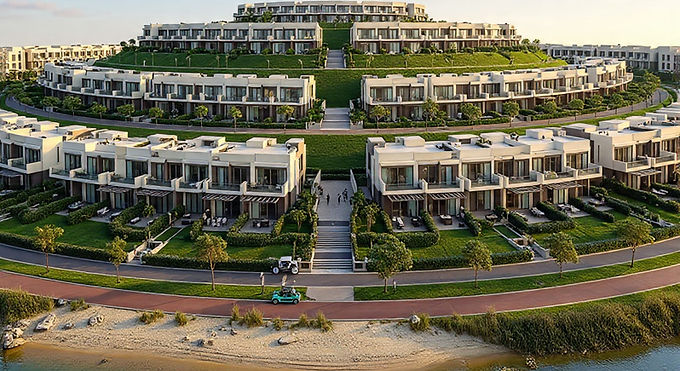
1.2 Construct a standard artificial island of 50 rai to create a pancake-shaped mound 5 meters high, covering an area of 30 rai. The lower island will be 3 meters high from the normal ground level (according to the BH 2-0 model https://aphichaphuttakaya.wixsite.com/mirror/copy-of-blue-heaven-2-1 to prevent flooding), and the upper island will be 5-10 meters high, depending on the risk of flooding, for prominence, receiving wind and sunlight, on the base of the mound from the lower island, 3 meters above the normal ground level.

1.3 Construct an artificial island. To construct a 15-meter-high earthen mound over a 30-rai (approximately 12-acre) area (based on the BH 2-1 model: https://aphichaphuttakaya.wixsite.com/mirror/blue-heaven-2-1-model) in preparation for building row houses and single-family homes on the high earthen mound. The mound will have a 3-meter-high base, offering 8 different house designs or options: https://aphichaphuttakaya.wixsite.com/infographic/sample-articitial-island#piramid
This is part of the MIT project on 11 land plots (based on the MIT model for the chosen investment location, as designed by VG). (https://aphichaphuttakaya.wixsite.com/website/project-m1-m7)

1.4 Assign VG the responsibility of constructing roads and a Super Block-style urban plan similar to that of Barcelona, Spain (https://aphichaphuttakaya.wixsite.com/website/m-9-lam-takhong#superblock-1), and building fountains at intersections or roundabouts and public ponds on the island.

Furthermore, VG proposes that the major investor only need to invest in the three points mentioned in sections 1.1, 1.2, and 1.3. Investment in the remaining 60 businesses is not necessary, as the major investor will generate income from renting out water-related areas such as floating hotels, land, organic farming, and from income generated by co-investors and minor investors purchasing land in the MIT project, which is the major investor's project.
1.5 If the major investor wants to invest in other areas of interest and is willing to take the risk of those investments, or build for resale in the remaining 60 businesses, such as an Entertainment Complex, Maldives, or retirement homes for major investors, their investment status in the remaining 60 businesses will change to that of a minor investor, with no end to the business opportunities.
1.6 VG is tasked with marketing and inviting co-investors, minor investors, and interested parties to purchase the artificial islands that VG has built or allocated, and to allow minor investors to invest in businesses on their own private islands or on shared islands in the remaining 60 businesses.
1.7 VG is tasked with providing the necessary infrastructure according to the allocated area and the number of houses built for sale as stipulated by land allocation laws.
1.8 VG is tasked with managing and providing common area services. 1. Maintaining water quality and protecting the environment.
2. Summary of expenses and income for major investors:
2.1 According to the MIT project design by AI and VG, both construction and sales will take approximately no more than 5 years, with a payback period of 4 years.
2.2 The Blue Heaven Package (BH) investment by AI and VG, both construction and sales, will take approximately no more than 4 years, with a payback period of 3 years. See example reports: Q4 Cash Flow for BH4-1 Option 2 and D BH4-1 Total: Master Price List for Major Investor (including 8 options).

Key Financial Highlights: BH4-1 Option 2
(4-Year Quarterly Cash Flow Projection)
-
Rapid Return on Investment: The project demonstrates a strong financial trajectory, reaching the Break-Even Point (BEP) by Year 3 (Q3).
-
High Revenue Generation: Accumulated Gross Revenue is projected to reach 9,850 Million Baht within the 4-year period.
-
Attractive Net Profit: After all capital investments and a 5% Vicharn Group (VG) management fee, the Net Cash Flow stands at a healthy 2,952 Million Baht.
-
Scalable Investment Structure: The total capital investment of 5,913 Million Baht is strategically allocated over the first three years to maximize development efficiency and investor returns.
-
Consistent Profit Sharing: A dedicated 5% management portion ensures long-term operational sustainability and professional oversight.

2.) Co-investors with major investors to invest in the MIT project. VG will invite co-investors to invest jointly with the major investor or main investor in the project in 11 locations on the major investor's land. The co-investors will have the following responsibilities:
1. Invest in building islands on 50-rai plots of land themselves, with the major investor not investing in this part.
2. Hire VG on a turnkey basis for island construction, marketing, sales, and central services.
3. Purchase 50-rai plots of land within the major investor's project area.
4.) Have VG design and construct artificial islands on the land, 50 rai per zone, within the major investor's project area.
5.) Have VG build townhouses and single-family homes on elevated hills, similar to the major investor's project.
6.) Have VG invite smaller investors to invest in specific businesses on the private or artificial islands invested in by the co-investors with the major investor in 60 businesses.
7.) The co-investors will give the major investor 30% of the net profit before the project is closed on the islands where the co-investors have invested.

3.) Minor investors to invest in the MIT project, VG will invite:
1. To purchase land, lease land, lease water surface, or lease-purchase land that is an artificial island, and to develop artificial islands on the mainland within the 11 MIT projects (https://aphichaphuttakaya.wixsite.com/website/project-m1-m7) where major investors are already sponsoring the investment.
2. To invest in the artificial islands in 60 businesses, employing VG as a representative of the major investors in those projects to construct them on a turnkey basis. https://aphichaphuttakaya.wixsite.com/2496/maldives-a1-a7 For example, building a resort on an island, building villas on an island, floating structures on land, or on a private island, etc.
3.) In the case of renting water surfaces, such as:
3.1 Solar Farm https://dulyawatphuttakaya.wixsite.com/my-site-3/floating-solar-farm-a6-11
3.2 Floating restaurants and hotels https://dulyawatphuttakaya.wixsite.com/my-site-3/floating-hotel-a6-12
3.3 Renting space 11 Types of Water Sports Equipment
3.4 Ocean Park https://aphichaphuttakaya.wixsite.com/2496/amusement-park-a3
3.5 Floating House or Office https://dulyawatphuttakaya.wixsite.com/my-site-3/floating-home-a6-10
3.6 Business Center https://aphichaphuttakaya.wixsite.com/2496/service-center-on-raft-a5 or Floating Services
3.7 Wellness, Floating Thai Massage Spa
4. Rental of an Entire Artificial Island for 99 Years https://aphichaphuttakaya.wixsite.com/2496/private-island
5. Exceptions or Reserved Rights: 1. Building row houses or single houses. 2. For the construction of artificial islands. Both transactions are reserved for major investors only.
6. Construction, Extension of Structures, or Demolition of Structures Due to the need to maintain the quality of water in the public wells, groundwater quality, and the safety of the entire artificial island structure, individual investors are not permitted to construct or modify the island without prior written permission from VG, MIT management, or the relevant legal entity. Failure to do so will result in legal action. This is especially true for the construction of flood-proof glass houses, alterations to the existing row houses, or the driving of piles onto the island.
.jpg)
4.) Special Investors – For investment outside the MIT project, which VG will invite:
1. Investors interested in purchasing land as compiled by Vicharn Group (VG) and from those offered for sale at https://dulyawatphuttakaya.wixsite.com/my-site-3/prime-land-ready-to-sale, and a portion of which will be offered for the MIT project.
2. Investing in purchasing the MIT operating license to operate the project independently, with VG as the project consultant.
3. Owners of land who want VG to construct artificial islands for them. VG offers Turnkey Project models BH4-1 (on 50 rai of land) and BH4-2 (on 70 rai of land).
4. Purchasing a franchise in the MIT project, with VG as the consultant. VG offers Turnkey Project models BH4-1 (on 50 rai of land) and BH4-2 (on 70 rai of land).
5. Landlords who own large amounts of land (100 rai or more) don't know what to invest in. Holding onto it only results in taxes, or they can only continue paying taxes, or they can rent it out for agriculture, as seen in the landlord crisis of 2026 (https://aphichaphuttakaya.wixsite.com/mirror/copy-of-blue-heaven-4-model#land-lord-69).
6. The owner intends to use part of the inner land for a business that will bring development and increase the value of the outer land.
7. Land exceeding 2,000 rai that needs to be developed.
8. Landowners whose land mostly consists of large swamps, overgrown areas, or those unsure of what business to start. Unable to resell due to lack of buyers, VG proposes a Turnkey Project in the following models:
8.1 Model BH2-0 (Constructing a 5-meter high hill on 50 rai of land) https://aphichaphuttakaya.wixsite.com/mirror/copy-of-blue-heaven-2-1
8.2 Model BH2-1 (Constructing a 15-meter high hill on 50 rai of land) https://aphichaphuttakaya.wixsite.com/mirror/blue-heaven-2-1-model
8.3 Model BH4-1 (Building row houses on 50 rai of land) https://aphichaphuttakaya.wixsite.com/mirror/blue-heaven-4-1-model
8.4 Model BH4-2 (Building row houses on 70 rai of land) https://aphichaphuttakaya.wixsite.com/mirror/blue-heaven-4-2
8.5 Special investor provided. Based on the amounts in the table (assuming figures), report D BH4-1 according to the selected option:
1. If the Special Investor authorizes Vicharn Group (VG) to secure funding, and VG successfully secures all funding according to the investment amount in point 3,
2. The Special Investor will willingly grant VG a 10% stake in that project. The Special Investor must provide a written notice of intent to transfer the 10% stake throughout the project's duration as proof of this transfer.
9. Owners of clay pits or sand pits who don't know what business to start. Unable to resell due to lack of buyers, VG offers Turnkey Project models BH4-1 (on 50 rai of land) and BH4-2 (on 70 rai of land).
9. Landowners or business owners who want to prevent future flooding of their land, especially those experiencing recurring flooding. 10. Businesses whose activities require large amounts of water for cooling high-temperature equipment, such as Data Centers or small SMR nuclear power plants, and who cannot discharge wastewater into groundwater or public waterways due to the risk of toxic contamination.
11. Landowners or business owners seeking a Turnkey Project for land development or land with existing buildings on prominent, non-isolated, and flood-free land.
General Investor Details
Topic 1: The MIT project, or the Smart Green Project (All MIT, All Green), and the Superblock road plan, which includes the following components or uses:
1.) AI: Designing construction, analyzing daily, weekly, monthly, quarterly, and annual financial operations, and providing early warnings.
2.) IT: Collecting and displaying data in a way that is difficult to modify.
3.) Using an application to display and update construction results (real-time for executives, major investors, and minor investors) and financial results (real-time for executives and major investors) via mobile phones.
4.) An intelligent detection room or radar room (SCPR) for displaying and warning of intrusion, air attacks, and attacks from drones, air vehicles, and balloons (MIT projects with an area of 5,000 rai or more).
5.) Sensors to warn of water quality and quantity, display soil quality, and intrusion by underwater and aerial drones. Interior and Exterior
6.) Use drones and aerial surveillance vehicles (within 5 years)
7.) Use robots for central services as needed.
8.) Have a water filtration plant to treat wastewater and maintain quality sufficient for koi farming, and porous road surfaces to allow rainwater to drain quickly into public ponds, preventing waterlogging (similar to Japan, Germany, and Spain) (MIT project with an area of 2,000 rai or more)
9.) Implement a Superblock road layout, or Superilla in Catalan, an innovative urban planning model from Barcelona, Spain, which focuses on reclaiming road space from cars for pedestrians.
The Core of Superblock
Area Grouping: Take approximately 9 existing building blocks (3x3 size) and lower the level of internal traffic, allowing cars only on the outer surrounding roads.
Speed Limit: Only authorized vehicles are permitted inside the area (e.g., residents' vehicles). Vehicles such as delivery trucks must have a speed limit of no more than 10 km/h.
Multipurpose areas: Transform existing intersections and roads into parks, playgrounds, cultural activity spaces, and bicycle paths.
Main goal: To reduce air and noise pollution, increase green spaces, and create a more interactive society.
.jpeg)
Topic 2: Example of Net Profit and Investment Model BH4-1 to invite entrepreneurs, or 1.) sand quarry owners, 2.) clay quarry owners, 3.) landowners with water wells, or 4.) those with land (containing sand) with more than 100 rai of soil and at least 50 rai of land, to invest, based on AI calculations.
The investment would involve constructing a 50 rai artificial island, building row houses on a 15-meter high hill with a 150-meter radius from the base of the hill on approximately 22 rai of land, building 480 two-story row houses (Option 2) at 100 sq m each, and 900 single-story houses (Option 5) at 50 sq m each.
Note: The calculation report table from the AI (Owl) in Table D, BH4-1 Total: Master Price List for Major Investor (8 Options), shows that the investor provides all the funding for construction. If Vicharn Group (VG) successfully provides all the funding, the investor, according to the investment model... BH4-1 It is necessary to transfer ownership of 10% of the shares in the project to VG, and a letter of authorization to hold the shares is required.
Item 1.) Investment under Option 2 involves building two-story townhouses on hillside land, each 100 sq m (total usable area 100 sq m), totaling approximately 480 units.
Item 2.) Investment under Option 5 involves building one-story townhouses on hillside land, each 50 sq m, totaling approximately 900 units. According to the table, the returns for Option 2 and Option 5 are:
1.) Net profit of 49.92% and 53.68%, respectively.
2.) There is an annual bonus for investors of 5%, amounting to 492.5 million baht and 308.3 million baht, respectively.
3.) Net profit returned to investors of 2,952 million baht and 1,938 million baht.
4.) Return on investment in the 3rd year, as shown in the document. B
.jpeg)
Topic 3: The major investor, who is also the investor in the MIT project (as per point 1.2), has purchased some or all of the 11 land plots and wishes for VG to undertake each MIT project for approximately 5 years as a Turnkey Project. VG proposes the following roles for the major investor in the MIT projects:
1. The major investor will provide the funding for the entire period that VG is contracted to manage the project.
2. VG will be hired as a turnkey investor, or assigned to manage the entire project, including design, supervision, construction, central management, and implementation of points 3-6 below. For transparency, a system for collecting and recording operational data according to the plan and actual progress will be implemented, with alerts for relevant departments. Progress, financial transparency, and real-time construction data will be displayed via a mobile app.
The following tasks must be undertaken by VG:
1. Construction
2. Production: Temporary organic agricultural production will be carried out on vacant land not yet developed into artificial islands, utilizing the land effectively and preventing it from becoming overgrown. 3. Centralized services.
4. All of these can generate summary reports for daily, monthly, and annually submission to the major investor, and for auditing by the major investor's representatives using Trinity Software, or the Trinity Program, developed from an American-style car service and sales center management system. This system was developed for Chrysler Thailand Co., Ltd. and has been in use for nearly 30 years. It features a system that prevents unauthorized modification or alteration of data, including deletion. The only person authorized to modify the system is Professor Dulyawat Buddhagaya, CEO of MIT VG TSA and the sole author of Trinity Software. The Trinity Software is stored in a remote location, completely disconnected from the internet, providing 100% protection against hackers.
3. The major investor's primary business is investment in the design and construction of artificial islands. The project involves dredging mud and sand to create artificial islands on the mainland, with sizes of 30, 50, 100, and 500 rai. Construction timeframes are estimated at approximately 365, 605, 1,175, and 5,720 million baht, respectively (AI data is subject to change). Construction periods are 2.7 years, 3.3 years, 4.3 years, and 7.6 years, respectively (AI data is subject to change). This will provide permanent flood protection, along with public rainwater harvesting ponds and white sandy beaches.
4. The second main business of the major investor is the design and construction of 15-meter-high earthen mounds on the artificial islands:
1.) Single houses on the earthen mounds
2.) Row houses on the earthen mounds
3.) Container houses on the earthen mounds
For example, on a 30 rai artificial island, houses would be built in tiered rows on 15-meter-high earthen mounds, in a circular shape with three stories, arranged in a pyramid shape. With a base diameter of 150 meters, the area would be approximately 22.02 rai. The surface area of each layer would decrease according to the slope of the hill. Generally, the surface area might be about 1.5–2 times the base area, depending on the slope.
4.1.) 135 single-family homes on 100 sq.wa. plots can be built. Reducing the common area (roads, gardens, swimming pool): this might result in approximately 110–120 homes [estimated from actual usable area]. Note: This is an AI calculation, and the figures may change during actual construction and depending on the slope of the hill.
4.2.) Approximately 800–900 townhouses with usable area of 50, 75, or 100 square meters can be built, approximately 580–650, and approximately 430–480, respectively.
This would include pedestrian walkways and access for electric bicycles or electric golf carts in front of the houses, with sufficient common area.

Topic 4.) Sources of Income for Major Investors
4.1 Primary Income from Core Businesses 1-2: 1.) Creating artificial islands and 2.) Building single-family homes, townhouses, and container homes on hills. Investment in the 63 core businesses is not necessary. The sale of artificial islands can be priced at 5 million baht per rai, and profits can be generated from two-story single-family homes (100 sq.w. each) and two-story townhouses (50, 75, or 100 sq.m. per room), potentially exceeding 100% profit margins, significantly higher than the 20-25% profit margin typically found in typical housing developments.
4.2 Secondary Income
1.) Contracting services for minor investors through VG. 1.) Design and construction in 61 water-related businesses (excluding artificial island construction and townhouse/single-family homes on hills) where small investors wish to invest on allocated artificial islands.
2.) Leasing of water surface areas and land, such as:
Leasing of water surface areas for hotels, restaurants, floating houses and offices; leasing of islands for 99 years to foreigners or Thais; leasing of entire artificial islands; leasing of areas for 11 types of water sports equipment; and leasing of water surface areas for floating solar farms.
3.) Receiving fees from permits for activities or transactions, such as tolls, rental income from sales areas, and income from organic farming on the land before or after the artificial island construction.
4.3. Income as a small investor, indefinitely, from investments of interest similar to other small investors in the over 60 water-related businesses presented by TSA, such as investing in a luxury hotel on their own private artificial island. This income pertains to the artificial island as a small investor. 6. Major investors will not need to undertake central infrastructure or public utilities such as wastewater treatment and waste collection again, as VG has already provided these on the perimeter of the artificial island.
7. Major investors can invest in businesses of their interest, similar to other smaller investors, in 60 water-related businesses. Some major investors may choose to operate these businesses themselves, thus becoming smaller investors in this area. This allows them to continue operating smaller businesses even after the artificial island allocation is completed within 5 years.
8. VG will be encouraged to construct public utilities as advertised, such as a 100-140 meter high fountain, roads, drainage systems, waste collection, security, and central services. This includes building a Japanese-style water filtration plant (on land of 2,000 rai or more) and a Smart Control Room (SCPR) as a center for air and underwater drone attack defense (on land of 5,000 rai or more), with VG responsible for these.
9. Central services will be provided in accordance with land allocation laws. 9. The project will be managed by VG and will conclude within approximately 5 years, or once the sale of the artificial island land plots is complete.
The project duration is approximately 5 years. After that, the common areas will be transferred to the juristic person once the artificial island land plots are fully sold. The land or water areas that remain the property of the major investor will continue to generate rental income and benefits from the business as minor investors, without having to be responsible for the maintenance of the common areas anymore.

Section 5. Obligations that investors should be aware of in investing in the hypothetical model BH4-1 (as assumed) https://aphichaphuttakaya.wixsite.com/mirror/blue-heaven-4-1-model, on land zoned at 50 rai per zone, designed and calculated by AI according to international standards, for investment within and outside the MIT project. The investor has 3 obligations as follows:
Obligation 1: Provide land with an area of 100 rai or more, including 50 rai or more of water area.
Obligation 2: Provide funds for investment. Choose your investment option based on the type of townhouse or single-family homes on a hill, as shown in the example table in Report D BH4-1 from AI.
1. Options 1-8 represent the number of houses that can be built. Three rows of townhouses or single-family homes can be built on a semicircular hill 15 meters high with a diameter of 300 meters, resulting in a hill area of 22.1 rai.
2. To build townhouses with room sizes of 50, 75, or 100 square meters, approximately 800–900 single-story units, 580–650 units, and 430–480 units can be built, respectively, according to https://aphichaphuttakaya.wixsite.com/infographic/sample-articitial-island#piramid
3. Approximately 110–120 single-story single-family homes on the hill, each with a usable area of 100 square wa, can be built. https://aphichaphuttakaya.wixsite.com/infographic/sample-articitial-island#sigle-house
4. Only one investment option can be selected.
Note: The figures in the sample table are generated by AI.
1.) Report D BH4-1 Total: Master Price List for Major Investor (8 Options) and
2.) Investment plan based on reports A and B, designed with values from points 1 and 2 automatically calculated and linked.
3.) Figures are generated from the given problem, defining standard and international values for materials, labor, time, size, and area on a 50-rai plot.
4.) Some displayed figures may appear overestimated. In reality, the system displays reports from the Trinity software.
4.1 Income and expenditure management is based on the annual budget. If any budget allocation has a surplus, it is easy to verify. and ultimately return to the financial statements or major investors.
4.2 Reports will be sent to investors or their authorized representatives daily, monthly, and annually. No one can edit, change, or delete these reports except the CEO, who developed the Trinity software.
3. Assign VG the responsibility of managing the design, contracting, and quality control of the construction according to the turnkey model BH4-1 (as assumed) at every stage.
4. Assign the responsibility of monitoring or delegating the monitoring responsibility to a committee to follow up and verify the results. Based on the daily reports, summarizing monthly and annual income and expenditure, along with graphs on the website or app, regarding construction progress, financial status, and the status of common area services:
Item 5: Transfer common area services and utilities to the juristic person based on progress reports on construction, finance, sales, and common area services held every 3 months.
Item 6: Based on progress reports on construction, finance, sales, and common area services held every 3 months.
Item 7: When the BH4-1 investment project (as assumed) is completed in 4 years, or when the island allocation is sold out in 5 years, it is necessary to transfer common area services and utilities to the juristic person as stipulated by land allocation laws.


Topic 6 Under the topics of Transparency, Good Governance, Trust, Anti-corruption, Universality/Internationality, and "Labour protection under the law," aims to demonstrate:
1.) Transparency, which means disclosing information, operations, or decisions that are verifiable, straightforward, and easily understood, building trust and preventing corruption; and
2.) Good Governance, which refers to sound management principles in both the public and private sectors, based on accuracy, transparency, accountability, and participation, to achieve fairness, efficiency, and well-being for the public or stakeholders. This encompasses key principles such as the rule of law, ethics, transparency, and responsibility between the employer (major investor or co-investor) and the contractor (VG and its associates), and between the government and the contractor (VG and its associates), and between the government and the employer; and 3.) Compensation for services rendered between the employer (major investor or co-investor) and the contractor (VG and its associates).
This also applies to the allocation of investment funds for human resource management and administration for the major investor. All joint ventures with major investors, or investors under the Blue Heaven (BH) model, allocate investment funds for management and employee incentives, and comply with all applicable personnel laws. Referring to the figures in Table D BH4-1 Total: Master Price List for Major Investor (8 Options), these are:
6.1 According to item 9, "Team Salaries (Phase 1) 5%" to: 1.) MIT Executives 2.) Vicharn Group (VG) Executives 3.) The SUN Academy (TSA) Executives 4.) Advisory Committee (MIT, VG, and TSA) 5.) CEO Audit Committee 6.) Office and Accounting Staff 6.) Central Service Staff 7.) Maintenance Staff 8.) Laborers 9.) Clerks, Housekeepers, Drivers 9.) Employees 10.) Security Personnel 11.) Other related individuals
6.2 According to item 10, "Team Welfare Benefits (Phase 2) 5%" "Labour protection under the law," which includes bonuses (not subject to law), additional payments, payments according to the Social Security Fund, Workers' Compensation Fund, and payments as required by law, such as under labor law. Ministry of Industry expenses, such as safety uniform costs, and Ministry of Public Health expenses, such as maternity costs. [Link to relevant document: https://drive.google.com/file/d/19EaokeU6zlZycshyw1AzG9GNG3Bx36NU/view?usp=drive_link]
6.3 According to clause 13, "Deduction: 5% administrative fee for VG" (Plot 3) will be the compensation at a universal/international rate that should be paid to the contractor managing the project in the MIT project or the BH (Blue Heaven) model.
6.3.1 Mr. Dulyawat Buddhagaya, CEO, will allocate the funds and implement them in conjunction with the Vicharn Group management team, subject to the CEO's approval and consideration.
6.3.2 This also includes the funds under clause 6.3 as compensation or payments to individuals, groups of individuals, companies, or organizations that act as advisors, minority investors, major investors, or co-investors with minority investors. 6.3 This leads to business transactions and contracts at a rate of 3%, meaning VG will no longer need to claim this compensation from the three investor groups.
6.4 The investment amounts under clauses 6.1, 6.2, and 6.3 will be clearly documented, showing who received what, where, when, and in what amount, as well as any remaining balance. These records will be stored in the Trinity software and presented at quarterly meetings to the investors (the contracting groups) and VG management only. Daily, monthly, and yearly reports will not be displayed on the website; they will only be used to summarize figures by budget group.
6.5 The major investor reserves the right not to return any remaining funds as per clauses 6.1, 6.2, and 6.3 upon the project's completion within the normal 4-year period or if it does not proceed as planned.
6.6 Furthermore, all investment expenses outside of clauses 6.1, 6.2, and 6.3, such as construction costs, are excluded. In terms of engineering, land costs, and other expenses, if any remain as shown in Software Trinity within the 4-year plan, it will be returned to the investors immediately before the project is closed.
6.7 To provide compensation for intellectual property rights, public relations, and... This is funding for past work and an advance deposit for services to: 1.) Vicharn Group for the MIT management team on the development and design of all 11 MIT projects and the BH model, which commenced on August 9, 2023, for a total of 29 months. 2.) The use of Trinity Software produced by The SUN Academy (TSA) for 1.) construction, 2.) production, and 3.) central services. VG therefore wishes to propose to:
6.7.1 The major investor has invested in the MIT project, with royalties and other compensation of 100,000 baht per month (one hundred thousand baht) since August 9, 2023, and the cost of using Trinity Software is 300,000 baht per system (three hundred thousand baht), payable immediately before the turnkey contract date.
6.7.2 Co-investors with the major investor. 6.7.2 Joint investment in the MIT project, royalties and other compensation of 3,000 baht per month (three thousand baht only) from August 9, 2023, and the cost of using Trinity Software is 50,000 baht per system (fifty thousand baht only), payable immediately before the Turnkey contract date.
6.7.3 General investors in investments outside the MIT or BH project, royalties of 1,000 baht per month (one thousand baht only) from August 9, 2023, and if Trinity Software is used, the cost of using Trinity Software is 50,000 baht per system (fifty thousand baht only), payable immediately before the Turnkey contract date.
Furthermore, the funds under clauses 6.7.1, 6.7.2, and 6.7.3 are non-refundable.
.jpg)
Topic 7. Responsibilities of Vicharn Group (VG) must proceed with the Turnkey project as per the contract, with the following main responsibilities:
1. Starting with landscape improvement.
2. Creating a landscape by constructing artificial islands of 10 meters and 3 meters high, and a 15-meter high mound on an island within a 22-rai area (as per example images and videos).
3. Selecting contractors and overseeing all construction in BH4-1.
4. Arranging for a construction quality inspection team.
5. Arranging for safety certification of the artificial islands from a government or international institution (essential).
6. Marketing and sales presentation.
7. Receiving authorization for central administration.
8. Arranging insurance for the artificial islands and the townhouses or single houses on the mound, annually until handover to the juristic person.
9. Preparing:
9.1 Construction plan reports showing progress and results for each project and by zone.
9.2 Budget plans for each construction project or activity, showing expenditure results, remaining balances for each budget, and showing off-budget expenditures.
9.3 Public relations plans. Generate income from the sale of houses or other businesses, such as rental income from land on water or ponds, sale of commercial buildings, etc., and showcase the performance of the domestic and international marketing team.
9.4 Regarding central administration, there is the responsibility to report on the budget of income and expenses for central services, resolving grievances, handling complaints, providing services related to construction, repair, and maintenance of tools and machinery.
9.5 Records of work from 3 systems: 1. Construction, 2. Accounting and finance, 3. Central services. Submit these records to be displayed in reports 9.1 to 9.4 to show summary reports and graphical representations in daily, monthly, and annual reports. These reports can also be displayed on a website or mobile app, with restricted access requiring a password. Furthermore, financial documents and references to important and legally sensitive matters will be sent to the performance review meeting or via registered mail.
The operation according to point 9.5 will utilize:
1.) A data recording and reporting system via IT.
2.) Document verification using AI.
Specifically:
1.) The IT system uses three programs from the Trinity Software suite produced by The SUN Academy (TSA). These programs have been developed and used for nearly 30 years, offering 100% protection against modification and hacker intrusion because they are not stored on the cloud. Instead, the three programs are stored on servers not connected to the internet, within a computer room monitored by CCTV and security guards 24/7. Only one person can modify the data or access the programs or database: Mr. Dulyawat Buddhagaya, CEO of MIT and TSA, who is the sole author and developer of the Trinity Software suite.
2.) Document verification using AI. Important reports will be converted into PDF files and sent to a computer with internet access for continuous monitoring and immediate alerts to relevant employees and the CEO when any anomalies occur. This prevents potential human error.
Thailand's Land Crisis 2026
Topic 1 : Summary of key points from the video and PowerPoint presentation: [Thailand Land Crisis 2026]: The End of Thai Landowners: When Thais Become "Permanent Tenants" in Their Own Homes! From the video https://www.youtube.com/watch?v=_5R4GIBp7dU&list=PL7zJ0rriQYiIpXa8b7v6Lixmpgn6E-rw0&index=1 and the analysis by Owl AI https://aphichaphuttakaya.wixsite.com/mirror/copy-of-blue-heaven-4-model#land-lord-69 dated March 29, 2026.
1. The "Fleeing for Survival" Phenomenon of the Middle Class
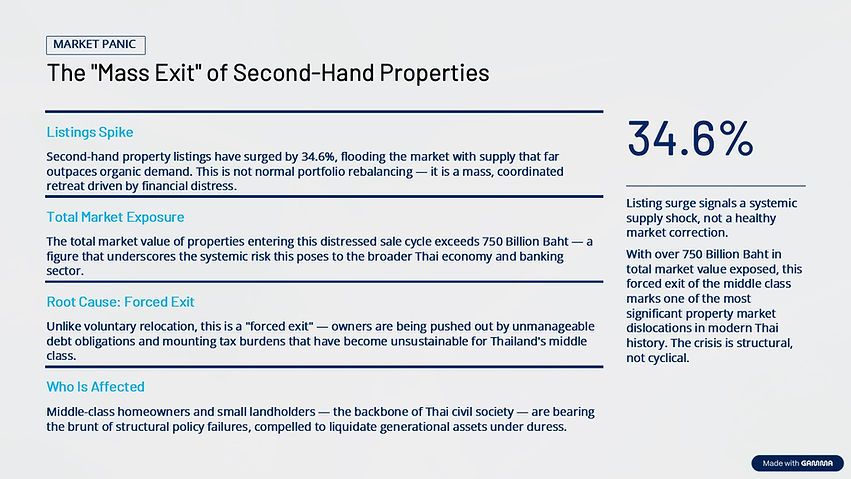
Alarming Statistics: Second-hand residential properties for sale have surged by 34.6%, totaling over 750 billion baht. This isn't because people want to move, but because they "can't bear the burden."
Deceptive Appraisal Prices: Vacant land prices have soared to 447.2 points (a 44% increase in some areas), but people's incomes have grown by less than 3%. This makes it impossible for ordinary people to afford the taxes, forcing them to sell their last remaining assets.
2. The Double-Edged Sword of the "New Land Tax":
100% Collection: The government has abolished tax relief measures and implemented a progressive tax system. If land is left vacant for more than 3 years, the tax rate will increase by 0.3% every 3 years.
Inequality in Adaptation: * Small-scale Owners: Those with inherited land worth 10 million baht must find tens of thousands of baht in cash to pay taxes annually.
Large-scale Owners: Using "fake agriculture," growing bananas/lemons in the heart of the city. To reduce taxes from millions to tens of thousands.
3. The encroachment of "multinational capital" (Global Land Grab)
Land buffet: The 99-year lease policy and allowing 75% foreign ownership of condominiums have become a gateway for large capital (both legitimate and shady) to inflate land prices through nominee mechanisms.
Impact: Traditional Thai people are pushed to the fringes of the city and become "permanent tenants" on land their ancestors once owned.
4. The "Vertical Slum" time bomb (The Low-Cost Trap)
Lowering standards for profit: As land prices rise and labor costs soar, real estate developers reduce room sizes and use lower-grade materials to secure loans.
Condominium crisis: In the next 5-10 years, when residents can no longer afford the maintenance fees, public utilities will collapse, becoming difficult-to-manage vertical slums.
5. The faceless future of Generation Rent
Losing the opportunity to build a life: 37% of young people choose to rent for life. Without a face to provide collateral for loans, the dream of owning a business (SME/Startup) is virtually impossible. They must forever be laborers in the capitalist system for the landowners.


Topic 2: Content Verification Evidence (Verification Source: MONO NEWS - Decode) from Mr.Owl AI on March 29, 2026
1. Second-hand land sale crisis (Supply Shock)
Confirmed data: The number of second-hand residential properties for sale has surged by 34.6%, with a total value exceeding 750,000 million baht.
Cause: This is not due to normal relocation needs, but rather from economic hardship and increased tax burdens that are beyond the means of the middle class.
2. Inequality in land prices and income. (Price-Income Gap)
Confirmed data: In suburban areas (e.g., Bang Phli, Bang Bo), land prices increased by as much as 44% (Q3 2025), but people's income base grew by less than 3%.
Reference index: The index of vacant land prices surged to 447.2 points and expanded by more than 10% continuously for the first time in many years.
3. Land and Building Tax Burden
Confirmed data: In 2026, the government will collect taxes at the full rate of 100%; there are no relief measures.
Penalty measure: If vacant land is left undeveloped for more than 3 years, the tax rate will increase by 0.3% every 3 years until the ceiling is 3%.
Comparative example: Inherited land worth 10 million baht, if not developed commercially... 1. Cash must be prepared to pay 30,000 - 100,000 baht per year in taxes (while large corporations use "disguised agriculture" to pay taxes of only 0.01% or 10,000 baht per 100 million baht of land).
4. The Encroachment of Foreign Capital and Nominees (Foreign Land Grab)
Confirmed data: There are attempts to push for a policy extending lease terms to 99 years and allowing foreigners to own up to 75% of condominiums.
Impact: Multinational capital inflates land prices through nominee mechanisms, driving land prices beyond the means of a 400 baht minimum wage for Thais. This forces Thais to move to the "margins of the urban periphery."
5. The Rent-Only Society
Confirmed data: Surveys indicate that 37% of young people (Gen Z and Alpha) choose to rent for life because they lack down payments and do not want to bear long-term debt.
Economic Risk: Without land titles (the primary collateral for loans), young people will have limited access to capital for starting businesses. (SME/Startup) and must remain laborers in the capitalist system of the landowner forever.
6. The "Vertical Slum" Phenomenon
Confirmed data: Construction costs increased by 2.8% and labor costs increased by 7.9%, forcing real estate developers to reduce the size of the area and lower the quality of materials (The Low-Cost Trap).
Future failure: After 5-10 years, the property management system will go bankrupt because residents cannot afford to pay the common area fees, leading to the deterioration of high-rise buildings, which are more difficult to manage than low-rise slums.
Presentation Script: Decoding Thailand’s Land Crisis 2026
Verification Source: MONO NEWS - Decode | Analyzed by Mr. Owl AI
Slide 1: Title Page
-
Headline: Decoding the 2026 Land Crisis: When Title Deeds Become Economic Traps
-
Source: Verified Insight from MONO NEWS - Decode
-
Tagline: "Keep moving together with The SUN & Stay stronger with Mr. Owl AI, always."
Slide 2: The Supply Shock (Market Panic)
-
Headline: The "Mass Exit" of Second-Hand Properties
-
Evidence:
-
Listings spiked by 34.6%.
-
Total market value exceeds 750 Billion Baht.
-
-
The Cause: Not voluntary relocation, but a "forced exit" due to unmanageable debt and tax burdens on the middle class.
Slide 3: The Price-Income Gap (Market Distortion)
-
Headline: Skyrocketing Land Prices vs. Stagnant Income
-
Evidence:
-
Land prices in outskirts (e.g., Bang Phli, Bang Bo) surged by 44%.
-
Household income growth is below 3%.
-
-
Index: The Vacant Land Price Index surpassed 447.2 points, expanding over 10% annually—a historic high.
Slide 4: 2026 Land Tax – Full Enforcement
-
Headline: 100% Tax Collection: No More Mitigation
-
Policy: The government has ended all tax relief measures.
-
The Penalty: Vacant land left for over 3 years faces an additional 0.3% tax increase every 3-year cycle, capping at a staggering 3%.
Slide 5: The Injustice of Tax Adaptation
-
Headline: Small Owners vs. Mega Corporations
-
Comparison:
-
Small Owners: A 10M Baht heritage plot requires 30k – 100k Baht in annual cash—money most owners don't have.
-
Mega Corps: Utilizing "Artificial Agriculture" (planting bananas in city centers) to pay only 0.01% (approx. 10k Baht for a 100M Baht plot).
-
Slide 6: Global Land Grab & Nominee Strategies
-
Headline: Foreign Capital Encroachment
-
Evidence: Proposals for 99-year leases and increasing foreign condo ownership to 75%.
-
Impact: International capital inflates prices beyond the reach of local workers (400 Baht/day), pushing Thais to the "edge of the city's outskirts."
Slide 7: The Rise of "Generation Rent"
-
Headline: A Society Without Ownership
-
Evidence: 37% of Gen Z and Alpha choose to rent for life due to a lack of down payments and fear of long-term debt.
-
Economic Risk: No title deeds = No collateral. This cripples the ability to start businesses (SMEs/Startups), trapping a generation as permanent labor.
Slide 8: The "Vertical Slum" Time Bomb
-
Headline: The Low-Cost Trap & Structural Decay
-
Evidence: Construction costs (+2.8%) and labor (+7.9%) have forced developers to shrink unit sizes and use inferior materials.
-
Future Failure: In 5-10 years, failing Juristic Offices (due to unpaid fees) will turn high-rises into unmanageable vertical slums.
Slide 9: Strategic Solution: The MIT Model
-
Headline: Resilience Through Innovation (The Blue Heaven Way)
-
Content: Transforming high-risk land into high-value, safe, and sustainable ecosystems.
-
Focus: Advanced infrastructure (Seismic protection) and environmental sustainability (MBR Systems).
Slide 10: Conclusion & Call to Action
-
Headline: Secure Your Legacy, Protect Your Assets.
-
Closing: Don't let your land become a liability. Partner with MIT for a secure future.
-
Final Tagline: "Keep moving together with The SUN & Stay stronger with Mr. Owl AI, always."




Topic 3 Transcript: The End of Thai Landowners, by AI Owl, March 29, 2026
[00:03] We will take everyone on a deep dive into the crisis of the end of Thai landowners, where inherited land deeds, once a source of security, have become a tax burden that the middle class cannot bear, forcing them to rush to sell their land. We will trace whether the new tax structure and the encroachment of multinational capital are truly transforming Thais into permanent tenants of their own homeland. Let's decode this together in today's Decode.
[00:32] The Thai economy in 2026 is facing a major wave of change that is shaking the foundations of household stability: the transition from a landowning society to a permanent tenant society. This phenomenon is not just due to temporary factors, but is the result of the pressure of the new tax structure, the encroachment of multinational capital, and the adjustment of the real estate market that leaves the middle class behind.
[01:02] In the past, land was a symbol of freedom and security, but in recent years we are seeing signs of the largest desperate attempt to escape. Data from the Real Estate Information Center indicates that... The number of resale residential properties has surged by 34.6 percent, totaling over 750 billion baht. This isn't just a statistic; it represents the tears of the middle class, forced to sell their last remaining possessions to survive.
[01:31] Why are the dreams of owning a land title shattered? Because we are facing a situation of misleading land valuations. In areas like Bang Phli, Bang Bo, and surrounding provinces, land prices increased by 44.0 percent in the third quarter of 2025, while people's incomes grew by less than 3 percent. The vacant land price index has already surpassed 447.2 points and is projected to continue expanding by more than 10 percent for the first time in many years.
[02:03] This inequality makes it impossible for ordinary people to convert land into income to keep up with taxes and the cost of living. When land prices skyrocket beyond what actual purchasing power can afford, small-scale owners are forced to sell their properties on the resale market, where the buyers are mostly not ordinary citizens but rather those with abundant cash. This marks the beginning of the permanent loss of fundamental resource ownership for Thai citizens.
[02:32] Let's decode the mechanisms of the amended 2026 Land and Building Tax Law, which has become a painful double-edged sword. This year, the government abolished all tax relief measures and announced a full 100% tax rate with a progressive tax system, aiming to punish the ownership of vacant land. If left undeveloped for more than 3 years, the tax rate will increase by 0.3% every 3 years until it reaches a ceiling of 3%.
[03:07] For middle-class individuals who inherit land worth 10 million baht, if you don't develop it commercially, you must prepare 30,000 - 100,000 baht per year in cash to pay taxes. In a sluggish economy, this amount is a heavy burden, leading to the decision to sell. But what's even more concerning is the inequality in adapting to these changes. Giant real estate corporations have tools called tax advisors and disguised agricultural mechanisms.
[03:31] We therefore see banana and lemon trees neatly planted on prime land in the heart of Sukhumvit, transforming vacant land into agricultural land. With a tax rate of only 0.01%, this means that a 100 million baht plot of land owned by a billionaire would only cost 10,000 baht in taxes, while middle-class individuals with second homes or inherited land face taxes at rates many times higher. This policy inequality accelerates the concentration of land ownership.
[04:00] Currently, just 1% of the country's population owns over 66.9% of the total land. Laws intended to reduce inequality have thus become tools for legally acquiring land from ordinary citizens for the portfolios of publicly traded companies.
[04:23] While Thais are giving up, multinational corporations view Thailand as a land buffet. The direction of Global Land Grab in Thailand is becoming clearer through policies extending lease terms to 99 years and allowing foreigners to own up to 75% of condominiums. This is opening the doors for large capital from East Asia, both legitimate capital disguised as investors and grey capital embedded in the entertainment industry. Using nominee mechanisms to buy up land in strategic locations.
[05:00] This war isn't limited to the central business district; it has spread to new BTS lines, such as the Brown Line, which has seen a 19.2% annual land price increase, and the Blue Line, which increased by 18.5%. These multinational corporations are driving land prices higher than what Thais can afford. When land prices exceed the base wage of 400 baht, the ripple effect is that original Thais are forced to migrate to the outskirts of the city and become tenants on land their ancestors once cleared.
[06:10] When land is prohibitively expensive, yet Thais still need a place to live, real estate developers offer what's called the "Low-cost Trap": building budget-friendly condominiums that minimize living space to the point of being cramped and compromise on construction materials to keep the final price affordable enough to secure bank loans. This is a ticking time bomb waiting to explode in the form of vertical slums. Imagine a skyscraper crammed with people but lacking maintenance.
[07:26] The dream of homeownership has become a bedtime story for Gen Z and Gen Alpha. Surveys indicate that 37% choose to rent for life because they lack the down payment and don't want to carry debt for more than half their lives. But this chosen flexibility comes at the cost of sustainable security. In a rent-to-own economy, landlords profit from the rental income without producing anything new, while workers lose almost half their income paying rent for a cramped space.
[08:40] The land crisis of 2026 is a mirror reflecting the failure of the rental economy.