
Maldives in Thailand
Manmade Safe Places


Maldives Gallery
by AI+ Trinity Software (IT)


hot spring land A7.1
GEOTHERMAL SMART CITY
Geothermal Commercial Potential
"Disclaimer" : Images and details are part of the project MIT and Model BH development process and may be subject to change as needed depending on site conditions. We reserve the right to notify you of any changes in advance.
1.)Thailand's Geothermal : Based on information from Thailand Geothermal Moonshot
Based on information from Thailand Geothermal Moonshot https://thebulletin.org/2022/11/the-geothermal-moonshot/ , the topics are:
1. Underground Energy...An Opportunity for Thailand
2. How Geothermal or Geothermal Energy Benefits Thailand
3. More than 112 Hot Springs Nationwide
Explanation 1: Thailand does have underground energy.
More than 112 hot springs are scattered throughout the northern and western regions.
Data on oil and gas drilling – thousands of wells nationwide – indicates that Thailand's underground has real geothermal energy.
Explanation 2: Key Features of Geothermal:
24/7 Power Generation: Generates electricity 24 hours a day, 7 days a week, unlike solar power which only generates electricity during the day.
It's clean energy, reducing LNG imports and mitigating the risk of fluctuating global energy prices.
Suitable for Data Centers, AI, and factories that require continuous and uninterrupted power.
Thailand has the people and technology ready: drilling engineers, geologists, and oil and gas personnel, ready to immediately develop geothermal energy.
Clean, secure, sustainable energy, producing 24 hours a day, 7 days a week.
Explanation 3: It's not just about electricity production.
The benefits of geothermal energy are diverse, or Cascade Use:
1. Refrigeration and cold storage systems
2. Aquaculture
3. Drying agricultural products
4. Spas and health tourism
5. Heat for industry
Efficient use of energy in every ounce, or Cascade Use.
Explanation 4: Approaches suitable for Thailand:
Start with small projects of 1 to 5 megawatts, focusing on hot springs, then develop into large-scale geothermal projects in the future.
1 to 5 megawatts: Start small, expand to large-scale projects in the future.
There's no need to jump straight into large projects. Start small, prove it quickly, and then expand in depth.
Explanation 5 : Many countries are accelerating their efforts, such as:
The United States, which has laws and policies strongly supporting geothermal development.
India, which is pushing geothermal development as part of its national energy plan.
Mexico, a global leader in geothermal development.
Conclusion: Perhaps it's time for Thailand to seriously study this topic as well, because clean energy like 24/7 could be one of the key infrastructure components for Thailand's future AI and Data Center economy.
Additional information: Vicharn Group and its geological and geothermal energy advisory team are ready to bring their capabilities, experience, and expertise of over 50 years, along with AI, to the MIT project to extract geothermal energy. We are inviting large or major and minor investors, as well as interested parties outside the MIT project, to invest on geothermal.

2.) Vicharn Group would like to take this opportunity to officially launch Projects M4, M5, M6, and M9 on Tuesday, December 10, 2024, an auspicious day.
These projects comprise four locations with hot springs in five provinces: Phetchabun, Ranong, Ratchaburi, and Lam Ta Khong, Pak Chong, Nakhon Ratchasima. Specifically, Project M4 is in Phetchabun, Project M5 in Ranong, Project M6 in Ratchaburi, and Project M9 in Lam Ta Khong, Pak Chong, Nakhon Ratchasima.
If an investor expresses interest in any of these areas, Vicharn Group will send personnel to survey the quantity and quality of underground hot springs in those five provinces.
This is to build confidence among investors and aid their investment decisions. Investors will bear the survey costs, and Vicharn Group will proceed with the investment upon approval. According to the survey results, investors will then proceed to pay for the purchase of vacant land or purchase land and develop sub-projects with Vicharn Group.
Furthermore, Projects M 4, M5, M6, and M9 have a selling point: hot springs, to cater to Thai, Japanese, and Middle Eastern investors looking to develop resorts or retirement homes for Japanese and Middle Eastern residents. They also aim to create artificial islands with public hot springs that are permanently flood-free, or Japanese-style onsen baths within the residences, or to attract wellness investors.
Currently, there are 112 hot springs in 25 prefectures, according to [data source]. The Department of Alternative Energy Development and Conservation, in collaboration with Chiang Mai University (http://www2.dede.go.th/geothermal_gis/website/main_11.htm), has produced a collection of videos on natural springs in Thailand (23 videos in total: https://www.youtube.com/watch?v=f99qHpir7mM&list=PLschAZB_Q5Wf44LF3KVAPIeanz9qXBTuD&index=2) and the benefits of hot springs (8 videos in total: https://www.youtube.com/watch?v=GpAcu_774Qw&list=PLschAZB_Q5WdGCvqOxtWhXEMPYY3yPGHP2).
This demonstrates Thailand's livability and abundant underground resources. Finally, a list of all Vicharn Group (VG) projects is provided below: 1.) M1 Bang Khun Thian, Bangkok Sea; 2.) M2 Bang Pakong, Chachoengsao; 3) M3 Bang Bal, Ayutthaya; 4.) [Project details to follow]. M4 Phetchabun 5.) Project M5 Ranong 6.) Project M6 Ratchaburi 7.) Project M7 Bueng Boraphet, Nakhon Sawan 8.) Project M9 Lam Takhong, Pak Chong, Nakhon Ratchasima Shown on 1.) Website: https://dulyawatphuttakaya.wixsite.com/my-site-3/private-island #hotsprings
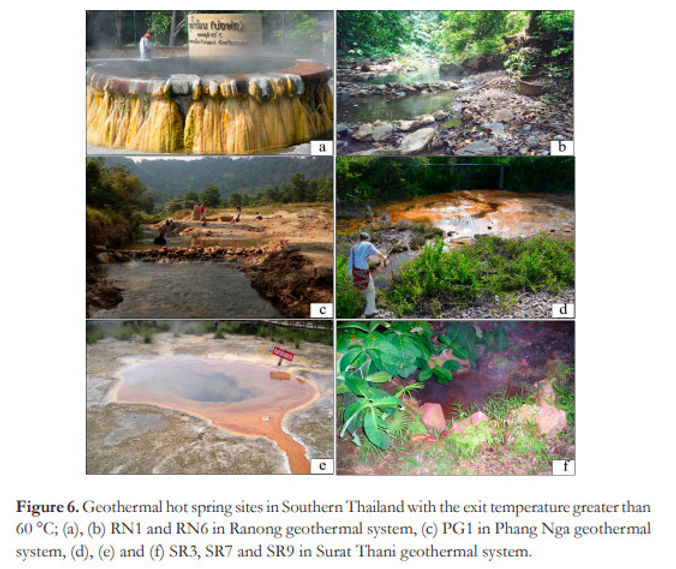

3.) Currently, there are over 112 hot springs in 25 provinces in Thailand, according to data from the Department of Alternative Energy Development and Conservation in collaboration with Chiang Mai University (http://www2.dede.go.th/geothermal_gis/website/main_11.htm).
Vicharn Group will kick off its hot spring projects on December 10, 2024, an auspicious day, with the launch of the M4 Phetchabun, M5 Ranong, and M6 Ratchaburi projects. These projects will feature hot springs as a key selling point, targeting Japanese and Middle Eastern investors looking to develop resorts or retirement homes for Japanese and Middle Eastern residents. The projects will also create artificial islands with hot spring public baths or Japanese-style onsen baths within the accommodations.

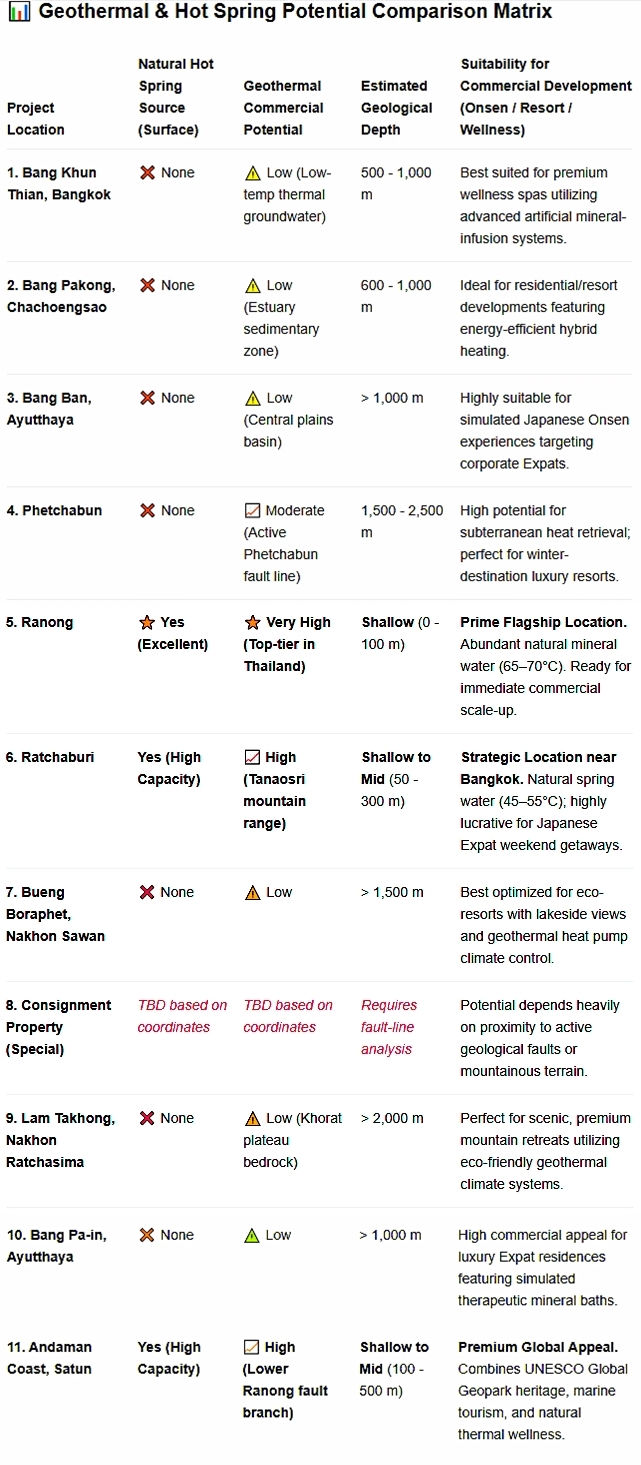
4.) The assessment of geothermal energy potential and natural hot springs in all 11 project areas is for the purpose of planning and proposing to investors. It includes in-depth geological information categorized according to actual commercial potential.
-
⭐ High-yield natural hot spring assets.
-
📈 Strong structural heat potential suitable for geothermal applications.
-
⚠️ Low direct thermal activity; recommended for hybrid/artificial mineral-infusion deployment.

5.) 🔍 Investor Insights Summary
1. Highest Potential Areas (Tier 1 - Recommended as Flagship Projects)
Ranong, Ratchaburi, Satun: These three areas possess genuine natural geothermal and hot spring sources with high surface water temperatures (45-70°C) in sufficient quantity for commercial viability, eliminating the need for massive drilling. The pure mineral water can be immediately extracted for Japanese-style onsen ryokans or luxury spas catering to international visitors, highlighting the selling point of "Real Natural Hot Spring" [1, 2, 3, 4, 5].
2. Bangkok and Metropolitan Areas (Bang Khun Thian, Bang Pakong, Ayutthaya)
Geologically, these areas lack natural hot springs and have a low probability of encountering geothermal energy due to thick sedimentary basins. However, commercially, this can be compensated for by the high location and high demand from Japanese expats and tourists, making them ideal for onsen projects. It is recommended to use shallow geothermal heat pumps in conjunction with artificial onsen heating and mineral replenishment systems to simulate the atmosphere [1, 2].
3. Geological Depth
In areas with hot springs ([Ranong, Ratchaburi, Satun]), hot water already flows up through cracks in the underground granite, making it possible to drill wells only 40 - 100 meters deep to extract a huge amount of hot water. However, in areas without significant fault lines, drilling deeper than 1,000 - 2,000 meters may be necessary, which may not be commercially viable if the intention is solely to extract hot water.
According to the research document Preliminary Play Fairway Analysis of Geothermal Resources in Southern Thailand and https://www.thaiscience.info/Journals/Article/CMJS/10990598.pdf

6.) 📍 1. RANONG: The Flagship Capital of Natural Onsen
“The 'Beppu of Thailand' – Unrivaled Geothermal Enthalpy and Pure Thermal Opulence.”
-
The Crown Jewel Asset: Nestled atop a shallow, high-yielding granitic formation, Ranong stands as Thailand’s most prolific geothermal asset. The site boasts pristine, crystal-clear mineral water entirely free from sulfur odor, surging naturally with an exceptional exit temperature of 65°C – 70°C at depths of less than 100 meters, guaranteeing a limitless commercial volume.
-
The Investment Vision:
-
For Elite Japanese Investors: The ultimate destination for ultra-luxury, authentic Japanese Ryokans and Sanctuaries, tailor-made to captivate the affluent corporate Expat community.
-
For Global Medical Wellness Visionaries: A prime setting for a world-class Integrated Medical Wellness Retreat, capturing the rapidly accelerating global demand for premium longevity and preventative health tourism.
-
📍 2. RATCHABURI: The Strategic Gateway to Wellness
“An Eco-Luxury Thermal Enclave – A Serene Sanctuary Just 2 Hours from Bangkok.”
-
The Crown Jewel Asset: A highly coveted tactical location commanding the majestic Tanaosri mountain range. Ratchaburi delivers a premium thermal yield of 45°C – 55°C at optimal shallow-to-medium depths (50–300 meters), offering developers an exceptionally low CAPEX requirement for drilling and system integration.
-
The Investment Vision:
-
The Connoisseur’s Weekend Getaway: Strategically positioned to serve as the ultimate Luxury Weekend Thermal Spa Estate for high-earning foreign executives and diplomats seeking a quick, exclusive escape from the capital.
-
The Circular Profit Blueprint: Designed perfectly for a high-efficiency Cascade Use Model, where residual thermal energy is diverted to power climate-controlled eco-villas, mineral-heated stone saunas, and farm-to-table organic hydroponics, drastically maximizing overall asset ROI.
-
📍 3. SATUN (Andaman Coast): The Global Eco-Luxury Destination
“Where UNESCO Global Geopark Heritage Intersects with Ultra-Luxury Thermal Healing.”
-
The Crown Jewel Asset: The absolute pinnacle of rare real estate. Situated on the lower extension of the fertile Ranong fault line, this site masterfully merges high-volume shallow mineral thermal springs with the breathtaking, untouched vistas of the Andaman coast, all safely protected under the prestigious mantle of a UNESCO Global Geopark.
-
The Investment Vision:
-
For Elite Middle Eastern & European Investors: Crafted exclusively for the world’s most discerning travelers, this location offers an unprecedented blueprint for Eco-Luxury Overwater Thermal Villas, complete with private mineral-infused thermal plunge pools overlooking pristine mangrove estuaries.
-
The Definitive ESG Asset: An institutionally backed green investment carrying the global stamp of UNESCO heritage, seamlessly positioning the project at the forefront of international Sustainable Wealth and Green Capital Funds.
-
📈 Concluding Pitch Summary
"We do not merely develop real estate; we curate carbon-free, high-yielding generational wellness infrastructure. Engineered by nature, validated by world-class science, and meticulously tailored for the global elite."

7.) Geological data of Ranong and Satun provinces are considered to be two areas with crustal structures most conducive to geothermal energy and natural hot springs with the highest commercial potential in southern Thailand [0, 4]. Detailed information is provided separately according to the geological structure of each province as follows:
🌋 1. Geological Data of Ranong Province (Ranong Geological Profile)
Ranong is the "Geothermal Energy Capital of Thailand" due to its complete rock structure and fault lines [4].
Major Fault System: Located on the "Ranong Fault," a major strike-slip fault that runs through southern Thailand [0]. This fault causes deep cracks and voids in the earth's crust, acting as conduits for hot water and pressure from beneath the earth to the surface [0].
Heat Source & Bedrock: The bedrock in most areas is Cretaceous Granite [0] This type of granite is special because it has a high natural decay of radioactive elements (U, Th, K) [0], causing it to accumulate a huge amount of underground heat. Combined with metamorphic rocks and sandstones with high thermal conductivity, it transfers energy to the surface [0].
Hydrogeology: Rainwater and groundwater seep down to a depth of several kilometers through cracks in the granite [0]. When heated by deep rock, the water is pressurized, boils, and flows back up along the Ranong fault [0], becoming a shallow reservoir. This makes drilling easy at depths of no more than 40-100 meters. The surface temperature reaches 65°C - 70°C, and the granite mineral water of Ranong is very pure, without a strong sulfur smell.
🌊 2. Geological Information, Satun Province (Satun Geological Profile)
Satun is an area with world-class geological diversity. Until it was registered as a UNESCO Global Geopark, it has unique characteristics:
Structural Fault System: Although located in the southernmost part, Satun is influenced by the "Lower Ranong Fault Branch" and its northwest-southeast branch faults. This structure creates fractures in the bedrock, opening channels for geothermal water to circulate and erupt as natural hot springs (such as the Thung Wa Hot Spring and the hot springs in Thale Ban National Park).
Bedrock and Stratigraphy: Satun's rock structure is very ancient and complex, consisting of Ordovician limestone and Triassic to Cretaceous granite. The limestone in Satun has numerous underground cavities and caves (Karst Topography), which function as large groundwater reservoirs (Excellent Aquifer Storage).
Hydrogeological Characteristics (Hydrogeology): Groundwater accumulates in limestone cavities and seeps through cracks to come into contact with hot granite masses at deep levels [0]. It then flows back up through limestone cracks, giving Satun its unique characteristics: high calcium and carbon content, average surface temperature of 40°C - 50°C at medium depths (100-500 meters), ideal for spa treatments for health and skin diseases.
📈 Comparison of Geological Advantages for Commercial Use (Investor Summary)
Ranong: Distinguished by "High Energy, Heat, and Purity," suitable for projects requiring immediate use of high-temperature hot water in Cascade Use (e.g., authentic Japanese-style onsen + energy-saving systems in resorts).
Satun: Distinguished by "Mineral Therapy and World-Class Reliability (UNESCO)," suitable for Eco-Luxury Wellness projects targeting European and Arab markets that appreciate nature, hydrotherapy (Medical Spa), and eco-tourism.
Geological data from Stanford Research (2023) confirms that both areas have a very low drilling risk due to the constant presence of cracks and groundwater in the system. [0]
